Monthly Archives: August 2012

Celebrating 50 Years of Studio Glass

2017-02-09T11:39:23-08:00

A California Glass Exchange at the Crucible Nov. 10 and 11, 2012
Two Days of Demos, Lectures, and Two Day Glass Art Exhibition

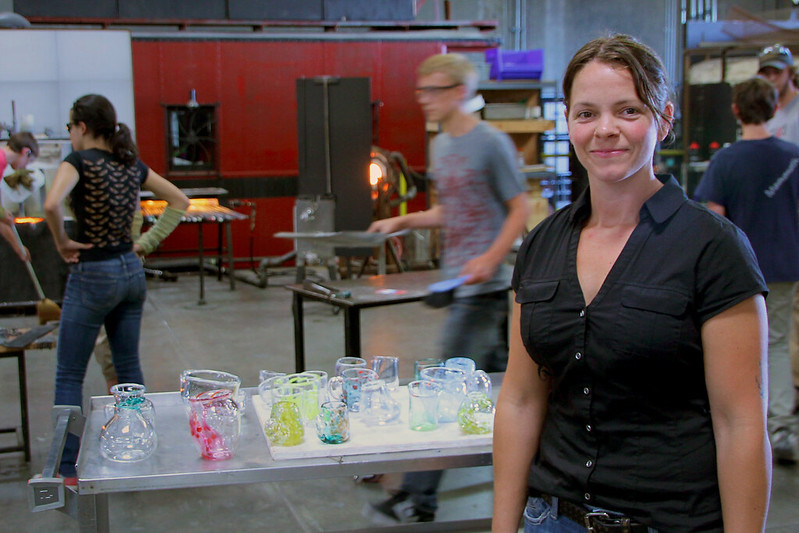
It’s easy for visitors walking into The Crucible’s main studio space to see how much glass means to our programs. From our furnace of molten glass kept orange-hot 24 hours a day, to the glass monsters and beads in our flameworking lab, glass is one of the most extensively used materials in our studio. It’s hot, glossy, temperamental and very sexy. 

“From the first moment I started working with glass, “said Keir Lugo, glass studio instructor, “I was hooked. It’s just unlike anything else.”

As a material, though, hot glass hasn’t always been accessible: through the 1950s glass used almost exclusively by industry. In 1962 artist Harvey Littleton gathered a group of artists, craftspeople, scientists and scholars at the Toledo Museum of Art for a series of workshops, demonstrating ways that glass could be manipulated outside of an industrial setting and beginning the Studio Glass Movement.

While the movement officially began in Ohio, more glass arts programs developed in California in the late 1960s and 1970s than in any other state. By 1975 vibrant glass programs had been established in higher educational institutions across the state, and many distinquished glass artists had begun to form their careers.

In the mid 1980s San Jose State University glass program founder Dr. Robert Fritz and his student George Jercich hosted the first  California Glass Exchange (CGE). The CGE was formed with as a regional, bi-annual conference with the goal of gathering the California glass community together to share skills and techniques. This fall The Crucible hosts a CGE Symposium, showcasing California glass artists and the history surrounding the art, with two days of glass demos, lectures and exhibition.  

The CGE Symposium is  a volunteer driven community effort, organized by the Crucible Glass Faculty, with support from The Crucible, The Clay and Glass Arts Foundation, the Glass Art Society, The Glass Alliance for Contemporary Glass, The Glass Alliance of Northern California and Denny Abrams. 

The event will showcase a spectacular set of glass art with over 60 presenters from around California. If you’re intrigued by the history and process of studio glass, this is definitely an event you will not want to miss.

Additional resources:
Celebrating 50 Years of Studio Glass2017-02-09T11:39:23-08:00

2012 Youth Summer Camp Update

2017-02-09T11:39:23-08:00

Carla Hall

Summertime at The Crucible brings one of our most popular youth programs, the Youth Summer Camps. Aaron Mason sat down with Carla Hall, The Crucible’s Youth Program Director, to talk about the program in process. Photos by Troy Mickins and Aaron Mason.

AM: Let’s start with a little background first.

CH: Sure! My name is Carla Hall, and I’m the Youth Program Director, amongst other things (laughing) here at The Crucible.

AM: And right now our big youth project is the Youth Summer Camps?

CH: That’s correct. Right now we’re in our fourth week of our Youth Summer Camp program, which I like to call “an industrial arts day camp.”

AM: How long do the camps run, and what do they provide?

CH: It’s five weeks of week-long day camps that give students a hands-on learning experience in industrial arts. They’re either full or half-day camps, depending on what the students have signed up for, but in either case young people get the chance to participate in huge range of classes including welding, blacksmithing, glass blowing and glass flameworking. This week alone we’re running 22 different classes.

AM: How many young people are we expecting to have through the program?

CH: We have a little over 600 students coming in over the five-week span. Traditionally the camp would span four weeks, but this is the first year we’ve had this level of interest and expanded into a fifth week of our most popular classes.

AM: Which parts of the program have been expanded?

CH: Glass blowing is the program that’s had by far the most growth. Last summer we ran a pilot program for just one week; this summer we’ve done glass blowing in four expanded weeks, and all of those classes have filled. The art bike program has continued to be popular as a day-long program as well. This is the first year we’ve also had the immersion program, which is a day-long experience with beginning and continuing skill level classes in arc welding, glassblowing, glass flameworking and blacksmithing. Those programs also filled pretty early in the registration process, and have seen increased popularity compared to last year

AM: And all of these are programs are for young students? They sound very adult.

CH: Yes! Once a student turns twelve they can come in and get hands on experience with flame or fire arts classes. The eight to eleven year olds participate in programs like clay, kinetics, wood carving, which are generally more age-appropriate.

AM: What do you tell people who are concerned about youth in this environment?

CH: We spend a lot of time transforming the shop into a youth-friendly, youth-safe space, including hiring a program staff who deal with supporting student needs, supporting instructors, providing a central meeting space, a break area, recess space and snack time. They’re doing a fantastic job providing the infrastructure that makes the camp so successful.

We also work to promote maturity and responsibility

2012 Youth Summer Camp Update2017-02-09T11:39:23-08:00
Go to Top